RMB Ventures (Pty) Limited. Reg. No. 2004/005571/07. A member of the FirstRand Banking Group.
Copyright © RMB Ventures (Pty) Limited 2026 All rights reserved. Copyright © FirstRand All rights reserved.

By Naeem Seedat and Sally Jansen
We now exist in a digitally transformed world. The rapid and mass adoption of digital technologies such as electronics, computing, mobile devices, the Internet, social media and artificial intelligence (AI) has forever altered the human experience, fundamentally changing the way we all live, work, communicate and entertain ourselves. Fully analogue experiences, it would seem, have now become more of an exception rather than the norm for most human beings, as ones and zeros infiltrate every aspect of our lives.
Enter the digital enterprise
Waves of digital innovation have disrupted markets globally, altering the very nature of competition across all sectors, as businesses, governments and entrepreneurs race to rethink the status quo, challenging old assumptions and reimagining production, consumption and service delivery through digital eyes.
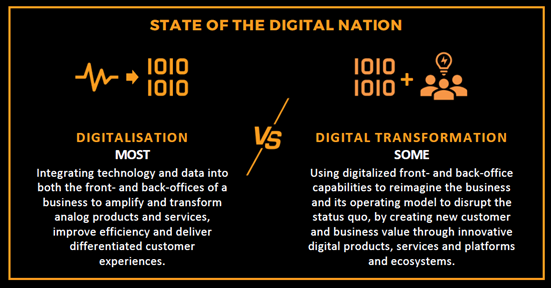
Most leaders in South Africa and beyond now understand the strategic value of digitalization within this broader context, directing their technology teams to devote considerable resources towards integrating digital technologies and data into both their front- and back-offices to amplify and transform analogue products and services, improve efficiency and deliver differentiated customer experiences.
For some, these digitalisation journeys progress into holistic, enterprise-wide digital transformation, as leaders recognize the vast opportunities and significant competitive advantage that their digitalized front- and back-office capabilities make possible, enabling them to reimagine their business and operating models to create new customer, business and/or citizen value through innovative digital products, services, platforms and ecosystems.
Traditional, largely analogue businesses simply cannot match the abundant value created by these digitally transformed enterprises.
The people dilemma
Given that most digital transformations start out as digitalization initiatives, it is unsurprising that organizations tend to start with and then continue operating with a clear technology implementation bias. It is common for leaders to prioritise tech modernisation and re-platforming efforts as well as the pursuit of technology-enabled efficiencies and cost savings (especially through the use of digital channels, automation and AI) without fully considering the holistic impact on people and culture across the organization. People are often the last line on the digital transformation roadmap, marked for simple realignment and retraining after technology and process changes have been made.
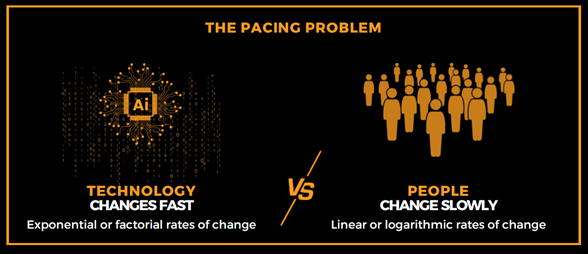
The challenge with this approach is two-fold. Firstly, organizations will encounter the pacing problem. Simply put, technology changes fast, while people change slowly.
As time goes by, the gap between what the market and the organization needs from its people versus what they can deliver gets larger and larger, to the point where it becomes somewhat unsustainable, necessitating a drastic reset of the talent pool.
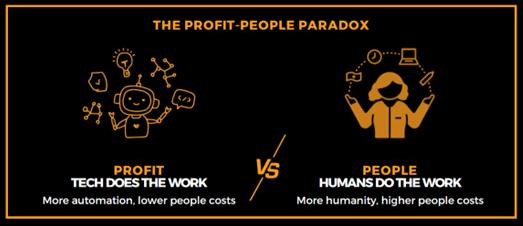
Secondly, profit-motivated and/or financially constrained organizations will need to confront the paradox that stems from their ability to use their digitally transformed enterprises to do more with less, particularly being able to generate greater profit or output with fewer people.
Digital enterprises have the option of scaling the use of robotic workers (both hardware- and software-based) which enables tech to take on more of the work that was previously done by humans (at much lower cost), creating the perfect storm for pervasive job losses and human redundancy with associated negative social consequences.
Human-centred digital transformation
At RMB Ventures, we recognize that with anything now being possible in the age of digital everything, leaders of digital enterprises have an added responsibility to consider not only the immediate technical and financial implications of their decisions, but broader ethical and social consequences too. The old adage of “just because you can, doesn’t mean you should” now applies more than ever, especially when the potential to negatively impact people and society at scale is so high.
RMB Ventures sees human-centred digital transformation as offering an alternative path that imbues an abundance mindset, taking a people-first approach that recognizes the power of human beings when they are augmented with, rather than replaced, by technology.
Leaders who design their digital enterprises around people, purposefully invest in developing the digital intelligence (DQ) that their organization will need to not only compete with, but constantly outperform both their peers and new, digital native entrants.
Our humanity, ironically, is now a source of competitive advantage in the digital economy.
Ends.
loading form...